
MRR vs ARR isn't a question with one right answer. Ask ten SaaS founders how they track revenue, and half will say MRR without hesitation. The other half jump straight to ARR because that's what their investor update template asks for. Both are right, and both are missing half the picture.
MRR and ARR measure the exact same revenue. One just multiplies the other by twelve. But how you use each number, and who you're talking to when you use it, changes everything.
This post breaks down what each metric actually tells you, how to calculate ARR without fooling yourself, and when to lead with MRR instead. By the end, you'll know exactly which number to put in front of your board, your investors, or your own Monday morning planning session.
Key takeaways
- MRR and ARR measure the same revenue at two different scales. One tracks the month you're in; the other tracks the year investors care about.
- MRR is your pulse check. It shows what's happening in your business right now, before a quarter's worth of noise buries the signal.
- Getting your ARR calculation right matters more than founders realize. Get the formula wrong, and your investor pitch deck starts the meeting on shaky ground.
- Neither metric outranks the other. Context decides which one leads, whether that's a board meeting or a Tuesday planning session.
- Both numbers are only as reliable as the data behind them. Sloppy revenue tracking turns MRR and ARR into guesses dressed up as facts.

{{ inline_toc }}
What is MRR and why it matters
Monthly recurring revenue is the predictable revenue your business collects every month from active subscriptions. If you have 100 customers paying $50 a month, your MRR is $5,000. That figure excludes one-time fees and annual contracts collapsed into a monthly average. It only counts the recurring piece.
Say a 20-person customer success team signs up for your platform at $30 per seat. That's $600 a month from one account. Add a few dozen accounts like that, and MRR becomes the number that tells you, in real time, whether your business is growing or stalling.
MRR works as a pulse check because it updates constantly. You can watch it move month to month, catch a slowdown in signups before it becomes a pattern, and manage cash flow without waiting for a quarterly close. Investors care about ARR, but you and your team live inside MRR.
That immediacy is also its limit. MRR tells you what happened last month. It doesn't tell you what a customer is worth over a year, or how your revenue base has changed shape. For that, you need to zoom out.

How to calculate ARR (and get it right)
Annual recurring revenue is the annualized version of your recurring revenue. For a simple subscription business, the formula is straightforward: MRR × 12. If your MRR is $50,000, your ARR is $600,000.
Companies with more complex contract structures calculate ARR by summing the annualized value of every active contract. A customer on a two-year deal worth $24,000 contributes $12,000 to ARR each year. This method holds up better once you have annual contracts, tiered pricing, or multi-year deals in the mix.
The calculation breaks down fast when founders mix in revenue that isn't actually recurring. A one-time implementation fee, a support add-on someone canceled after a month, or a services contract that won't repeat next year: none of that belongs in ARR. Include it anyway, and you've built an investor pitch deck around a number that won't survive diligence.
Churn causes the same problem in reverse. If ten customers cancel in March, your ARR needs to reflect that drop immediately, not at your next quarterly review. An ARR figure that doesn't account for churn is optimism, not accounting.
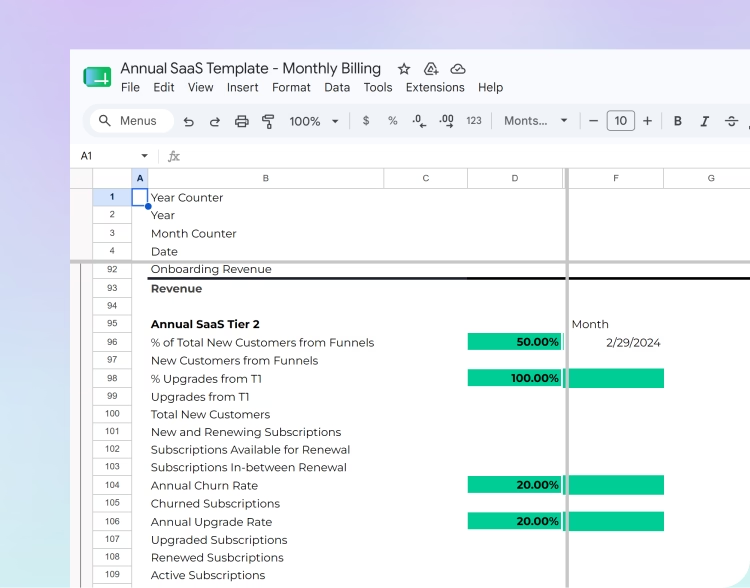
If your ARR calculation wouldn't hold up under investor scrutiny, grab a free SaaS financial model template and see MRR and ARR calculated correctly, automatically, every month.

MRR vs ARR: what's actually the difference
Once you've defined both, the differences come down to four things: time horizon, audience, use case, and how the two interact.
MRR operates on a monthly clock. ARR operates on a yearly one. That sounds obvious, but it changes what each number is good for. MRR reacts fast, which makes it useful for operating decisions. ARR moves slower and smooths out monthly noise, which makes it useful for planning and valuation.
Time horizon
MRR: Monthly
ARR: Annual
Best for
MRR: Cash flow, trend-spotting, day-to-day ops
ARR: Board reporting, fundraising, valuation
Who cares most
MRR: Founders, finance, ops teams
ARR: Investors, board members, acquirers
Reacts to change
MRR: Fast (visible within a month)
ARR: Slow (smooths short-term swings)
Simple formula
MRR: Sum of active monthly subscriptions
ARR: MRR × 12, or sum of annualized contracts
The two numbers work together. ARR is just MRR stretched across twelve months, so a healthy ARR depends entirely on a healthy MRR feeding it. If your MRR is unstable, those swings will eventually show up in your ARR too, just later and harder to explain.
When to use MRR and when to use ARR
Context decides which number leads. MRR belongs in internal conversations: monthly planning meetings, cash flow reviews, and any decision about hiring or spend that depends on what's coming in this month. It's the number your finance team should watch every week and report on each quarter.
ARR earns its seat when you're talking to people who think in years, not months. Investors evaluate SaaS companies on ARR because it maps directly to valuation multiples. Open a fundraising conversation with MRR instead, and you'll spend the first ten minutes explaining why that's not the number they expected.
This is exactly where the investor pitch deck comes in. Your ARR slide should show the trend behind the number: new ARR, expansion ARR, and churned ARR broken out separately, the same way you'd break down MRR internally. A single ARR number with no context invites more questions than it answers.
Board meetings usually want both. Board members expect ARR to track progress against your annual plan, but they'll ask about MRR trends too if something looks off between quarters. Knowing your SaaS revenue model cold, and being able to explain how it produces both numbers, is what separates a founder who's prepared from one who's guessing.
Neither number replaces the other. MRR keeps your operations honest. ARR keeps your fundraising story straight. For a deeper breakdown of which startup metrics matter at each stage, that's worth its own read.
{{ inline_cta }}
How MRR and ARR connect to your broader SaaS metrics
MRR and ARR feed into the rest of your SaaS metrics stack, and get explained by it in turn.
Churn rate is the clearest connection. A rising churn rate shows up first in your MRR movements, specifically the churned MRR component, before it ever dents your ARR. Watching churn at the MRR level gives you a head start on fixing the problem.
Net revenue retention builds on the same data. When your expansion MRR outpaces your churned MRR, you've hit net negative churn, and your ARR grows even without adding new logos. That detail turns a good unit economics story into a great one.
The Rule of 40 leans on these numbers too. Your growth rate, half of that formula, is usually calculated from year-over-year ARR growth. Get your ARR calculation wrong, and your Rule of 40 score is wrong too, along with every decision you make based on it.
None of these connections matter if the underlying MRR and ARR numbers are shaky. Get the base metrics right first, then build the rest of your metrics stack on top.

Common mistakes founders make with both metrics
A few mistakes show up often enough to call out directly:
- Counting non-recurring revenue as MRR. One-time fees, hardware sales, or a single big services contract don't belong in your MRR. Include them, and your growth trend becomes fiction.
- Switching to ARR before you have stable contracts. If your customer base is mostly month-to-month and unpredictable, an ARR figure just annualizes that instability. Wait until your revenue base has some consistency.
- Not tracking MRR movements separately. New MRR, expansion MRR, churned MRR, and reactivated MRR tell four different stories. Lump them into one number, and you lose the ability to diagnose what's actually driving growth or decline.
- Presenting ARR to investors without knowing the assumptions behind it. If an investor asks how much of your ARR came from one enterprise deal that might not renew, you need an answer ready. Not knowing your own number in a pitch meeting is worse than a bad one.
Two numbers, one confident founder
Knowing the MRR vs ARR difference cold means you never fumble a revenue question, whether it comes from a board member, an investor, or your own head of sales. You'll know which number to lead with, and just as importantly, why.
Forecastr builds these numbers into every financial model we help founders create, so MRR and ARR update automatically, and nobody's stuck refreshing a spreadsheet by hand. Founders who know their numbers make faster decisions and win more deals, because confidence reads clearly in a pitch meeting.
If you're ready to see your MRR and ARR modeled out, with the assumptions behind them laid bare, schedule a demo and we'll walk you through it.
Frequently asked questions
How do I calculate ARR for my SaaS startup?
For simple subscription pricing, multiply your current MRR by 12. If you have annual contracts, multi-year deals, or usage-based pricing, sum the annualized value of every active contract instead. Leave out one-time fees and anything that isn't guaranteed to recur.
Can I have ARR without annual contracts?
Yes. ARR expresses recurring revenue on a yearly basis, regardless of billing frequency. A customer paying monthly still contributes to ARR. You annualize their monthly payments to get there.
Which metric do investors care about more?
Most investors default to ARR because it maps to valuation benchmarks and shows year-over-year growth clearly. Investors who dig into diligence will still ask about your MRR movements, especially churn and expansion, so treat ARR as one important number among several.
What is a good MRR growth rate for an early-stage SaaS startup?
Many early-stage SaaS companies target 10 to 20 percent month-over-month MRR growth, though this varies widely by market and stage. What matters more than hitting a specific number is understanding why your MRR is moving the way it is, and being able to explain that trend clearly.
What is the difference between MRR and ARR?
MRR is the recurring revenue you collect each month. ARR is that same recurring revenue annualized, either by multiplying MRR by 12 or by summing annualized contract values. They measure the same underlying business, just on different clocks.