
You already have the numbers: a revenue target, a burn number, maybe a headcount plan sitting in a separate tab. What's missing is a single plan that ties them together and holds up when a board member starts asking questions.
That's the gap financial planning for startups is built to close. Strategic financial planning is the discipline of turning your goals into a forecast you can defend, stress-test, and use to make decisions.
This matters most once ad hoc budgeting stops holding up. It works fine early on, when it's just you and a co-founder making calls over Slack. It stops working once you've got a board, a hiring plan, and investors who expect you to know your numbers cold.
This guide walks through what strategic financial planning means, the building blocks every plan needs, and a step-by-step process for building your own forecast. Along the way, you'll see how to plan for growth and profitability together, setting targets for both on purpose.
Key takeaways
- Financial planning for startups turns individual metrics into one forecast you can defend to a board or investor, and you keep coming back to it as things change.
- Growth and profitability get treated as a tradeoff. A good plan sets targets for both.
- Scenario modeling (base case, best case, worst case) is what separates a strategic plan from a static budget.
- The plan is only useful if you compare it to actuals on a regular cadence. A forecast nobody revisits is just a guess with extra steps.
- The pieces that break most plans are structural: no cash timing, no scenario range. The math is rarely the problem.

{{ inline_toc }}
What is financial planning for startups?
Financial planning for startups means turning your company's goals into a forecast for revenue, spending, and cash, one you can update and defend as conditions change. Founders who do this well keep revisiting the plan every month.
Think of it as the connective tissue between your individual metrics and the decisions you have to make. Your CAC, your burn rate, your headcount plan: those are all inputs. The plan is what happens when you put them together and ask what they mean for the next 12 to 24 months.
A budget tells you what you intended to spend. A strategic financial plan goes further: it models revenue, expenses, and cash together, tests how that model holds up under different conditions, and updates as reality moves.
Done well, it becomes the document you open before a hiring decision, a pricing change, or a board meeting: the plan you reach for constantly, well beyond fundraising season.
Why founders outgrow ad hoc forecasting
Something forces the issue: a board deck, a fundraise, a hiring plan that's gotten too complicated for gut feel.
For some, it's the first real board deck, the one where a director asks how a hiring plan affects runway and “let me get back to you” isn't a good enough answer. For others, it's a fundraise, where diligence means defending assumptions line by line rather than pointing at a top-line number. And for a lot of founders, it's simply the moment a hiring plan gets complicated enough that gut feel stops being reliable.
Ad hoc budgeting is usually the right tool early on, when the business is simple enough that one person can hold the whole picture in their head. The problem is that it doesn't scale. A budget built for a five-person team doesn't flex when you're adding three roles a quarter and juggling multiple revenue lines.
This is also where the difference between a budget and a forecast starts to show up in practice. A budget sets a spending ceiling for the year. A forecast is a living estimate of where revenue, expenses, and cash are headed, updated as new information comes in. Growth-stage companies need both, connected to each other, which is a big part of what separates a startup budget from a forecast.
If this sounds familiar, you've outgrown the spreadsheet you built at seed stage. It's time to build the plan that replaces it.

The building blocks of a strategic financial plan
A strategic financial plan is four connected pieces, each answering a different question about where the business is headed.
Revenue forecast
This is your model of how the business grows: new customers, expansion revenue, churn, and the assumptions behind each one. A good revenue forecast is bottoms-up, built from drivers like conversion rate and deal size, not a top-down number picked because it sounds achievable.
Expense and headcount plan
Headcount is usually the largest expense line for a growth-stage company, and it's the one most likely to be undermodeled. Every planned hire needs a start date, a fully loaded cost, and a ramp period before they're productive. Headcount planning done well protects your runway. Done poorly, it eats into that runway a few hires at a time.
Cash flow and runway
Revenue and expenses tell you what the business earns and spends. Cash flow tells you when money actually moves, a different question entirely. An enterprise deal on 60-day payment terms can make your income statement look great while your bank account tells a much tighter story.
Profitability targets
Margin needs its own target, one you choose on purpose before revenue and expenses decide it for you. Metrics like the Rule of 40 give growth-stage SaaS companies a shorthand for whether growth and profitability are moving in balance, or whether one is quietly winning at the other's expense.
Each piece can be modeled on its own. The strategic part is connecting all four, so a change in one, say a new sales hire, flows through to its effect on runway automatically.
{{ inline_cta }}
Forecasting for growth without sacrificing profitability
Founders often treat growth and profitability as opposite ends of a dial, where turning one up automatically turns the other down. That framing is a shortcut that oversimplifies the decision.
A strategic plan sets targets for both, deliberately. That might mean holding gross margin steady while you invest in sales headcount, or accepting a temporary dip in efficiency for two quarters because you're funding a specific initiative with a clear payback period. The point is to make tradeoffs on purpose, before you're forced into them.
Scenario modeling is the tool that makes this possible. You build three forecasts: a base case reflecting your most realistic assumptions, a best case where key drivers outperform, and a worst case where they don't. Scenario planning turns your forecast from a single guess into a range you've already stress-tested.
This is also where leading and lagging metrics earn their keep. Revenue is a lagging metric: it tells you what already happened. Pipeline coverage, trial-to-paid conversion, and sales cycle length are leading metrics: they tell you what's about to happen to that revenue number. A plan built only on lagging metrics is always a step behind. One that tracks leading indicators gives you time to adjust before the miss shows up on the income statement.
Step-by-step: building the forecast
Step 1: anchor to your historicals
Start with 12 to 24 months of actual performance, if you have it. Historical revenue, expenses, and cash trends tell you what's realistic before you start projecting forward. Skipping this step is how founders end up with hockey-stick assumptions nobody can defend in a board meeting.
Step 2: build revenue bottoms-up
Model the actual drivers behind revenue, not a top-line number that sounds good. New customers, average deal size, sales cycle length, and churn each get their own line, so you can see exactly what has to be true for the forecast to hold.
Step 3: set your expense assumptions
Layer in headcount by start date and fully loaded cost, then add recurring expenses like software and office costs, and irregular ones like annual renewals or insurance premiums. This is the step where a lot of plans quietly lose accuracy, because irregular expenses are easy to forget until they hit.
Step 4: stress-test with scenarios
Run your base, best, and worst cases against the same set of drivers. Change one variable at a time, like a two-week slip in sales cycle or a two-point increase in churn, and watch how it moves your runway. This is where you find out which assumptions your plan depends on.
Step 5: set your baseline
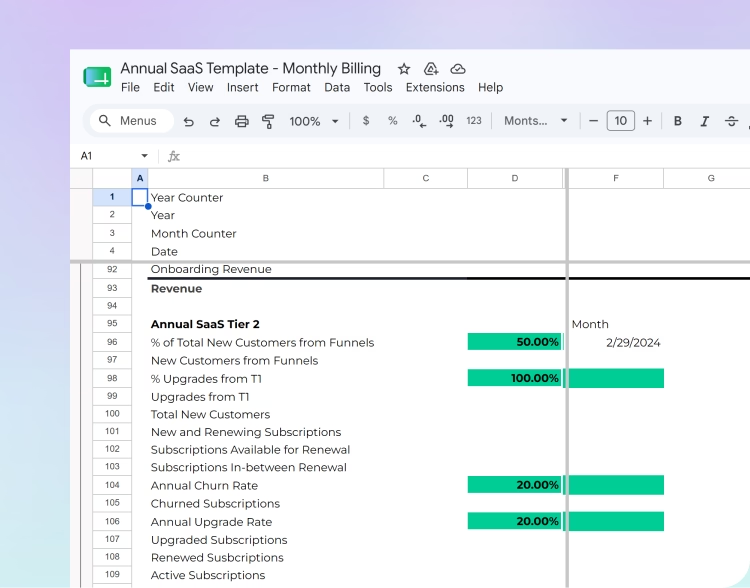
Once you've stress-tested the model, pick your baseline: the version you'll manage against and report to your board. This is also the point where a lot of founders build a proper financial forecast template, one with revenue, expense, and cash tabs that connect to each other, not three spreadsheets you reconcile by hand.
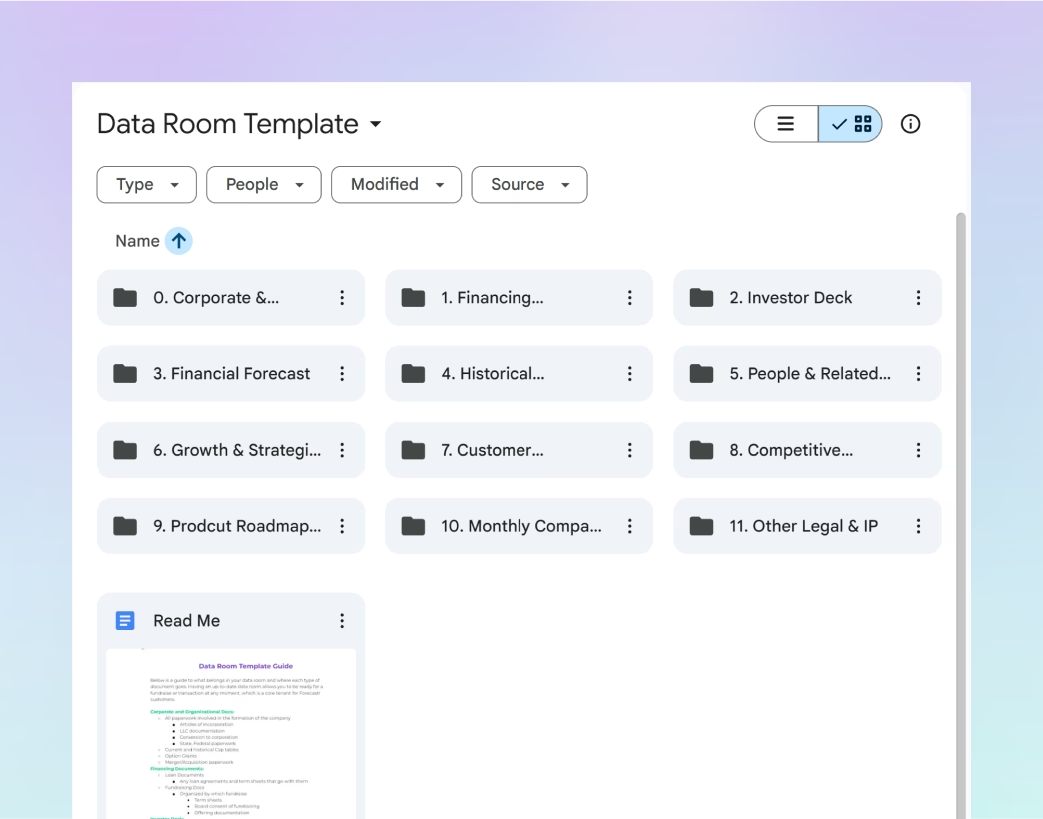
If you want a head start, grab one of our free financial model templates, built by business model (SaaS, marketplace, ecommerce, and more), to use as your starting structure.
Why a financial forecast template beats a blank spreadsheet
A financial forecast template gives you structure other founders have already tested: revenue, expense, and cash tabs that connect to each other, not a blank sheet you build from scratch. Starting from a financial forecast template also makes the plan easier to hand off, whether that's to a new finance hire or an investor doing diligence.

Making it a living process
A plan that gets built once and never revisited is a guess with a nicer format.
The habit that keeps a plan useful is a regular plan-vs-actual review: pulling real results, comparing them to what you forecasted, and understanding why the two diverged. A deal closing later than modeled, or a hire starting a month behind schedule, is normal drift. Each gap sharpens your next forecast. Budget variance analysis is how you turn those gaps into action.
Growth-stage companies typically land on a monthly review and a quarterly rebuild, tightening that cadence around a fundraise, a major hire, or a shift in sales performance. Knowing why and how to update your financial model as conditions change is what keeps that cadence from turning into a chore nobody follows.
Common mistakes that undermine the plan
A missing cash-timing assumption, or a single scenario with no range, breaks more plans than bad math ever does.
Leaving out cash timing is one of the most common gaps. A plan can show healthy revenue and expenses while completely missing that payment terms push real cash 60 or 90 days out from when a deal closes.
Building only one scenario is another: a single projection breaks the moment reality diverges from it, and reality almost always diverges.
Static spreadsheets that never get compared to actuals are a third failure point. A model nobody reconciles against real results monthly drifts out of date fast, and nobody notices until a board question exposes the gap. The fix for all three is built into the process above: model cash timing explicitly, build a scenario range instead of one number, and put a recurring review on the calendar before you need one.

Turning your plan into a habit
A strategic financial plan doesn't need to be perfect the first time you build it. It needs revenue, expenses, cash, and profitability connected to each other, and a habit of checking it against what actually happened.
Get those two things right, and the plan stops being a slide you dust off before a board meeting. It becomes the tool you reach for before every hiring decision, every pricing change, and every conversation with an investor who wants proof you've already thought this through.
Ready to make financial planning for startups less of a scramble every quarter? Book a demo to see how Forecastr helps growth-stage teams build a plan they can actually defend.
Frequently asked questions
What is financial planning for startups?
Financial planning for startups is the process of turning your company's goals into a forecast for revenue, spending, and cash, one you can update and defend as conditions change. Unlike a one-time budget, you keep revisiting it, stress-testing it against different scenarios, and using it to guide real decisions like hiring or fundraising timing.
How is strategic financial planning different from budgeting?
A budget is a fixed spending plan for a set period. Strategic financial planning is broader and ongoing. It includes revenue forecasting, scenario modeling, and profitability targets, and flexes as the business changes. Budgeting is one input into the plan, not the plan itself.
How often should a growth-stage company update its financial forecast?
Growth-stage companies typically review their forecast monthly and rebuild it quarterly, or sooner after a major change like a new round of funding, a big hire, or a shift in sales performance. The cadence matters less than the habit. A plan that's never revisited stops reflecting reality within a quarter or two.
Why forecast profitability separately from revenue?
Revenue growth and profitability don't move together on their own. A company can grow fast while margins erode, or grow slower while becoming more efficient. Forecasting them separately means setting that tradeoff on purpose, before growth quietly erodes your margin. Forecastr's platform models that relationship directly, so you can see how a growth decision affects margin before you make it.