
The pitch for AI financial modeling is easy to like. Describe your business in a prompt, get a financial model back. No formula hunting, no broken cell references at midnight.
And AI is fast. It can put together a startup financial model in minutes. Where it struggles is consistency and judgment. Every edit can quietly change the structure and rewrite formulas you never asked it to touch, and it fills the gaps in what it knows about your business with assumptions borrowed from someone else's.
That means every time you want to see a new scenario or a different outcome, you have to validate the entire model again, structure and assumptions both. Skip that step and the numbers still look polished. You'll believe them right up until an investor pulls a thread.
Here's where AI speeds up a model build, where it breaks down, and what to look for in a tool that keeps your financial forecasting consistent from one version to the next while you keep control of the assumptions.

Key takeaways
- AI can draft a model fast. Two things decide whether you can use it: whether it stays consistent as you edit, and whether its assumptions fit your business.
- It's weakest where it counts. Unit economics specific to your business, assumptions you can defend under questioning, and a record of how the model changed over time.
- Purpose-built platforms fix the consistency problem with a stable scaffolding and an engine that gives the same answer every time. The assumptions are still yours to own.
- A model you can't explain to an investor is a liability, no matter who built it.
{{ inline_toc }}
What "AI financial modeling" actually means right now
Two very different products share this label. Separate them before you compare anything.
The first is a general-purpose AI assistant: ChatGPT, Claude, Gemini, or Copilot in Excel sitting inside your spreadsheet. You describe the business, and it writes the cell logic or hands back a tab.
The second is AI-powered financial modeling inside a purpose-built platform. The assistant sits on top of a real forecasting engine, so it suggests calculations and generates cases while the underlying math stays built for startup finance. Most scenario planning software works this way too. The assistant writes the cases, and the engine holds the logic.
This is why so many takes on AI in finance talk past each other. One writer is describing a chatbot that produced a broken spreadsheet. Another is describing a platform created to harness AI with a proven scaffolding, native context, and guardrails purpose-built for this work.
Both are right about the thing they actually used.
So when you read that AI can or can't build your model, check which approach the writer meant. The answer changes completely, and it keeps shifting as agentic AI and AI agents start running multi-step tasks inside these tools.
Where the real difference sits
Under the hood, artificial intelligence tools like ChatGPT, Claude, and Gemini run on large language models, or LLMs. These are machine learning models trained on huge amounts of text, which is why they're great at writing and talking through ideas. Many AI systems built for finance run on those same LLMs. The difference is the specialized finance brain built around the model.
In a purpose-built platform, the skills that run multi-step work, like building a revenue forecast or setting up a scenario, come from financial modeling experts with hundreds of real-world repetitions.
The job the AI is given changes too. A general chatbot writes the whole answer, numbers included. The same generative AI that writes the sentence also produces the figure in the middle of it, so what you get is text that looks like a financial model.
A purpose-built platform splits those jobs. The LLM handles the words: it takes your natural language request and turns it into instructions like "add this revenue stream," "tie this expense to headcount," or "run this case." A separate deterministic forecasting engine handles every figure and calculation, so the same inputs give you the same answer every time, exactly as if you'd clicked the buttons yourself.
That won't save you from a bad assumption. Feed the engine a 3% churn rate and it will faithfully compound a 3% churn rate. What it does remove is a whole category of error where the number itself was never calculated in the first place. It also gets you closer to explainable AI, since every one of the model outputs traces back to a calculation you can open.

Where AI tools for financial modeling save you time
Credit where it's due. AI saves real time, and matching each use case to the right tool tells you exactly which parts of the modeling process to hand over.
Start with the first draft. Describe a subscription business and AI lays out the basics: revenue, headcount, expenses, a simple P&L. In traditional financial modeling, that's an hour of staring at a blank sheet. Here it's a few minutes.
Formula logic is next. Say "churn should compound monthly against starting customers" and you get something working to check. Checking is way faster than writing it yourself.
Error catching is another clean fit. Broken references, a percentage multiplied by a percentage, a SUM grabbing the wrong range. AI spots these patterns fast.
The last one is underrated: rebuilds. When pricing moves from seats to usage, your whole revenue build has to change. AI takes most of the pain out of that, though your revenue forecasting assumptions still need a fresh look.
Scenario analysis is where AI speeds up your forecast
Scenario analysis means keeping a few versions of the same model: a base case, an upside, and a downside where your raise slips two quarters, each with the same structure and different inputs. That kind of scenario modeling is repetitive work, and repetitive work is where AI shines.
Stress-testing is just as quick. Push churn to 6% and see what breaks first, runway or the hiring plan. AI builds those cases in seconds, and good scenario planning software lines them up side by side so you can compare your three futures at a glance.
Deciding what a realistic downside looks like is still your call, because AI only knows averages.
{{ inline_cta }}
Where AI in financial modeling goes wrong
The frame it builds can be wrong
Using Claude or ChatGPT on a blank Excel file means trusting it with the whole structure. One revenue line tied to the wrong driver throws off gross profit, then burn, then runway, and nothing looks off in the cell you're staring at.
It's often incomplete, too. A real picture is a three-statement financial model: the P&L, the balance sheet, and the cash flow statement that ties them together. Ask a chatbot for a 3-statement model and you'll usually get the first of those financial statements and not much else.
That's a big deal, because cash flow is what keeps the lights on. If customers pay on net 60, your P&L can look great while you're sweating payroll.
It doesn't know your unit economics, and usually doesn't ask
An AI model is only as good as the financial data you feed it, and it rarely tells you what's missing.
Ask for a SaaS model and you'll get one, whether or not you mentioned your sales cycle or how long onboarding takes. It fills the gaps with something plausible, and those quiet guesses become the assumptions your whole model runs on.
Try this: ask a tool to build you a model and count its questions before it starts. Experienced human analysts would ask a dozen, like how you price, how long deals take to close, and when you recognize revenue. Zero questions means it's guessing for you.
Plausible assumptions are the dangerous kind
Numbers that look wrong get caught. Numbers that look reasonable get shipped.
AI will happily hand you a CAC benchmark, a churn rate, a payback period. They sound familiar because they're averages pulled from data sources about other companies. Three percent monthly churn might be spot on for one startup and pure fiction for yours.
There's no audit trail
You'll revise assumptions between rounds, sometimes between board meetings. Six months later, someone asks why gross margin jumped from 68% to 74%. A chat thread is a lousy place to dig up that answer, and the question usually lands right in the middle of diligence.
Your numbers go somewhere
Building a model in a general chatbot means pasting in your real revenue, payroll, and customer data. Before the first paste, find the setting that controls whether your inputs get used for training. If those numbers sit under an NDA, check with your counsel first.
Why a human still has to look at it
AI is good at finding one kind of error and blind to the other. Broken references, a circular formula, a percentage multiplied by a percentage: those live inside the file, so a tool can catch them, often faster than you would. Judgment errors are the ones that slip through. A 3% churn rate compounds exactly as written, and nothing in the spreadsheet says 3% is wrong for your business.
That's where finance professionals come in. Someone who has built a lot of these knows where they usually break and which number to poke first. That kind of pattern recognition is the piece current AI capabilities still can't copy.

Generic AI vs. AI financial modeling tools
General AI is useful right up until the model needs to reflect how your business actually works. For a typical seed-stage startup, that's around draft two.
A chatbot has no memory of your actuals, no view of last quarter's numbers, and no clue that your enterprise deals take seven months to close. It only knows what you typed into the box.
A purpose-built platform closes that gap. The startup logic is already built in, so revenue, headcount, and cash tie together. Your actuals flow in, so the forecast stays current. Scenarios live side by side in one model. It's the kind of FP&A setup finance teams at bigger companies rely on, sized for a startup.
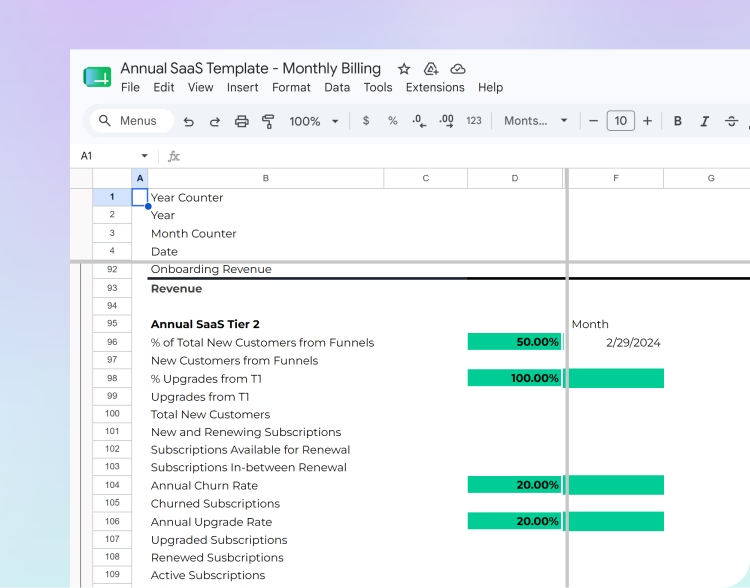
It also starts from a stable scaffolding and tested templates for different business models, so the structure holds steady from one version to the next.
When you're weighing financial modeling tools, whether that's a chatbot, a spreadsheet add-on, or full scenario planning software, ask four questions:
- Does it hold your actual numbers over time, or start fresh every session?
- Can you trace any output back to the specific assumption that produced it?
- When your business model changes shape, does the tool bend or does it break?
- Is there a human who will look at your model and tell you when something's off?
That last one matters more than you'd think. With Forecastr Vibe, AI builds your model on Forecastr's scaffolding, and a real human expert is always a click away. You pick how much help you want, from a few hours of analyst support up to a full fractional CFO, and you can change it anytime. So when a board meeting or investor pitch comes up, you've got backup. Our team brings the modeling skills and financial analysis that turn your numbers into financial insights you can act on, and that mix of speed and judgment is how you get a startup financial model you actually trust.
So, can AI build your financial model?
Partly, and the part it builds is worth having.
Let AI financial modeling handle the first draft, the formula mechanics, and the rebuilds when your pricing changes. That's real time back in your week.
Pair it with a platform that keeps the structure steady, so a new scenario doesn't mean re-checking every formula. The assumptions stay yours, because you're the only person in the room who knows why each number is what it is.
That matters most in front of investors. Walk a VC through a model you can't explain, pause when they ask about a number, and the meeting is basically over. Whether AI built the file or an analyst did makes no difference to how that lands.
Want to see what this looks like with a human in your corner? Join the Forecastr Vibe waitlist and be first in line when it launches. Until then, grab one of Forecastr's financial model templates.
Frequently asked questions
What's the best AI for financial modeling?
The best AI for financial modeling depends on what you need it for. General AI tools like ChatGPT can draft a rough model structure fast, but they don't understand your specific unit economics and won't keep the model current. Purpose-built financial modeling platforms that use AI to speed up setup, while leaving founders in control of the assumptions, tend to produce models investors actually trust.
Can ChatGPT build a startup financial model?
ChatGPT can draft a rough startup financial model structure in minutes: cell logic, a basic P&L shape, even simple scenario math. The gaps are your specific unit economics, a structure that holds steady as you edit, keeping the model updated as the business changes, and catching the errors only someone close to your business would spot. Treat it as a fast first draft and finish it yourself.
What are the risks of relying on an AI-built financial model?
The biggest risks of relying on an AI-built financial model are trusting assumptions you didn't generate and a structure that shifts every time you edit. A hallucinated growth rate can look perfectly reasonable and still be wrong for your business, and a formula AI quietly rewrote can throw off every number downstream. AI also won't flag when the model needs to change as the business does, so these models drift out of date faster than founders expect.
How do you implement AI in your financial modeling workflow?
Start with the mechanical parts. Let AI build models from a template, catch broken references, and spin up scenarios, then review every assumption yourself before anything reaches an investor. A few modeling best practices help: keep your actuals in one place, note why each assumption changed, and have someone who has built plenty of models check the output. That way AI automates the repetitive work and you keep the decisions.
Do investors trust financial models built with AI?
Investors care whether the founder can defend every assumption in the model, and the tool that built it barely registers. A model built partly with AI is fine as long as you own the logic and can explain it under questioning. A model nobody on the team can explain is the actual red flag.